
Hollow-Shaft vs Solid-Shaft Robot Joint Modules: A Sourcing Guide (2026)
An engineering and procurement guide to evaluating hollow-shaft versus solid-shaft robotic joint modules for humanoid, cobot, and industrial robot arms.
When designing a new robotic platform—whether it is a collaborative robot arm, an industrial SCARA, or an advanced humanoid—one of the earliest and most consequential architectural decisions is determining the structural configuration of the robotic joint modules. Specifically, engineering and procurement teams must decide between hollow-shaft and solid-shaft actuators.
This decision is rarely a simple matter of choosing one form factor over another. It dictates the entire cable routing strategy, impacts the thermal management of the arm, limits the choices for absolute encoders, and profoundly influences the overall cost and lead time of the supply chain. In my experience reviewing RFQs for robotic actuators, teams that gloss over this structural trade-off in the EVT (Engineering Verification Test) phase often face severe schedule delays and costly redesigns during system integration.
If you are sourcing robotic joint modules, this page provides a comprehensive breakdown of the technical and commercial boundaries of both architectures. It is designed to serve as a working reference for procurement teams, mechanical engineers, and system architects.
The Core Dilemma: Routing Complexity vs. Torque Density
The fundamental difference between a hollow-shaft and a solid-shaft module is the physical pathway it provides through its center of rotation.
- Solid-Shaft Modules: The center of the rotor and the gearbox is solid. Any cables supplying power, communication, or pneumatic lines to distal joints must be routed externally.
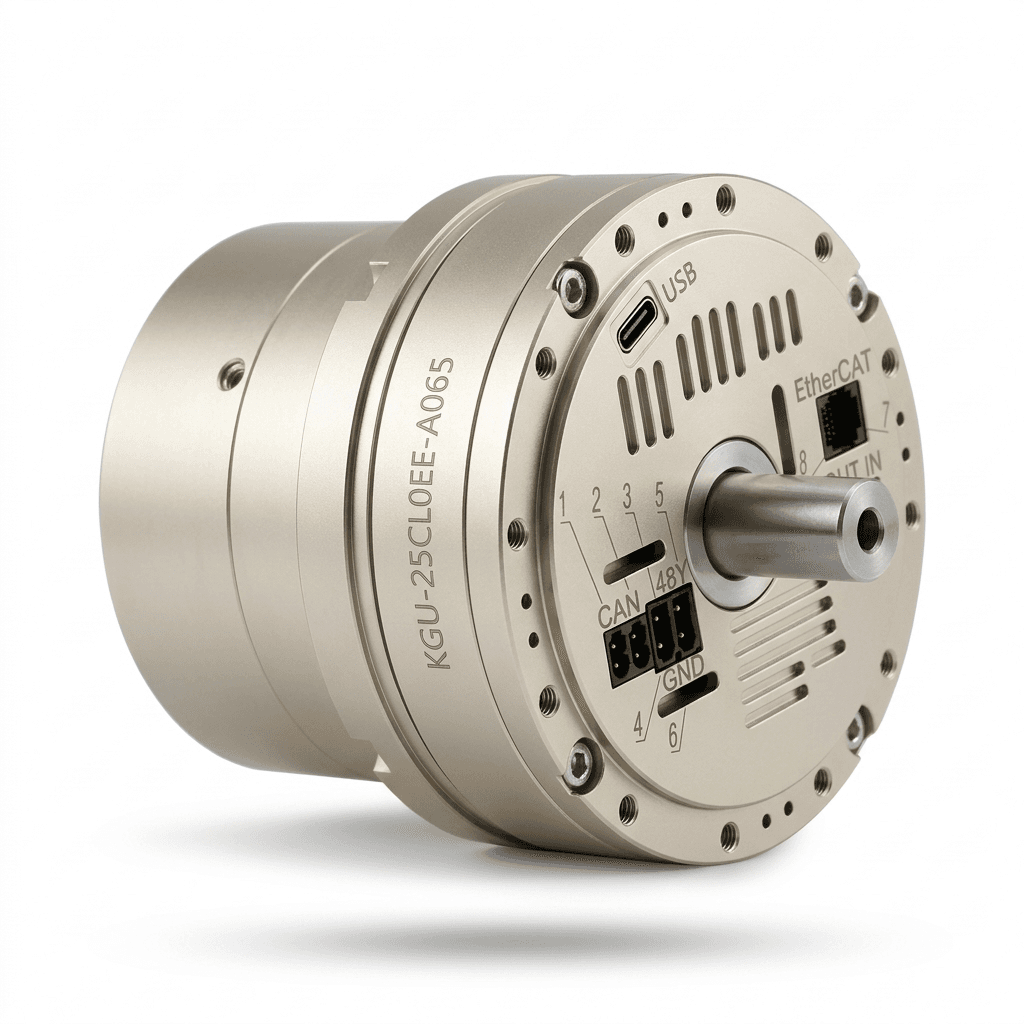
- Hollow-Shaft Modules: The module features a central bore (a physical hole through the motor, encoder, and gearbox). This allows cables, pneumatic tubes, or even optical fibers to pass directly through the axis of rotation.
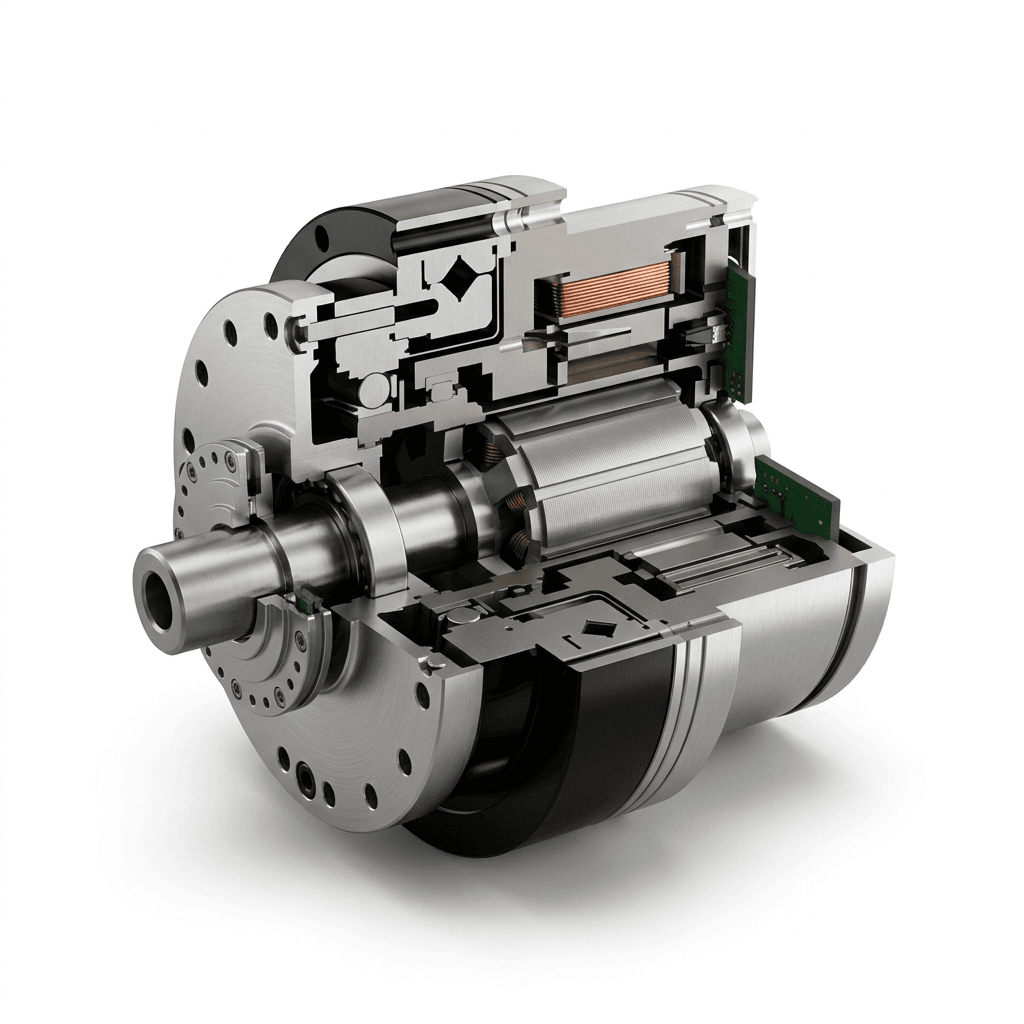
Engineering Visualization: Solid vs Hollow Architecture
Notice how the hollow-shaft design forces the motor windings and gearbox components outward to accommodate the central bore, reducing the effective volume available for electromagnetic torque generation compared to a solid shaft of the exact same outer diameter.
While internal routing sounds universally superior—it creates a clean, snag-free exterior that is critical for collaborative robots operating near humans—it imposes severe constraints on the internal design of the joint module.
When you specify a hollow bore, you are displacing the most space-efficient region for the motor’s rotor and the gearbox’s sun gear/wave generator. To achieve the same torque as a solid-shaft counterpart, a hollow-shaft module must either increase its outer diameter or increase its axial length.
Comparative Analysis: The OEM Procurement Matrix
When evaluating suppliers, do not rely merely on peak torque claims. You must look at how the structural choice impacts the rest of the joint’s performance.
Use this table to map the trade-offs during your supplier evaluation:
| Evaluation Criteria | Solid-Shaft Joint Module | Hollow-Shaft Joint Module | Sourcing & Engineering Impact |
|---|---|---|---|
| Torque Density (Nm/kg) | Highest. Maximizes the volume available for copper windings and gear engagement. | Moderate to High. The central void forces a larger outer diameter to achieve parity. | If weight and outer envelope are strictly constrained (e.g., humanoid knees), solid shafts offer superior power-to-weight ratios. |
| Cable Management | External. Cables must be managed via service loops, conduits, or exterior brackets. | Internal. Cables pass directly through the axis of rotation. | Hollow shafts eliminate cable snagging and reduce external footprint, crucial for cobots and medical robots in tight environments. |
| Cable Wear & Lifecycle | High bending stress on external service loops during rotation. | Torsional twist is concentrated over a short length inside the bore. | Hollow shafts require highly specialized, high-flex cables to survive millions of torsional twists within the bore. |
| Encoder Complexity | Simple. Standard on-axis absolute and incremental optical/magnetic encoders fit perfectly. | Complex. Requires off-axis or large-bore ring encoders. | Hollow-bore absolute encoders are significantly more expensive and have fewer supply chain alternatives. |
| Sealing / IP Rating | Straightforward. Easy to seal the solid output shaft against the housing. | Challenging. Requires inner bore sealing in addition to outer perimeter sealing. | Achieving IP65/IP67 on a hollow-shaft joint increases friction and module cost. Validate OEM sealing methods thoroughly. |
| Bearing Capacity | Uses standard crossed-roller or angular contact bearings optimized for the shaft. | Requires large-diameter, thin-section bearings to support the hollow rotor. | Thin-section bearings are more susceptible to deformation under high moment loads. Requires strict machining tolerances. |
| Typical Cost & Lead Time | Lower cost. Highly standardized components. Shorter lead times. | Higher cost (15-40% premium). Custom encoder/bearing supply chains. | A hollow-shaft requirement often narrows your viable OEM pool and pushes pilot lot pricing higher. |
Deep Dive: The Hidden Challenges of Hollow-Shaft Integration
If your application demands a hollow shaft—as is the case for almost all modern 6-DoF collaborative robot arms—you must be prepared to manage three critical engineering risks with your OEM.
1. The Cable Torsion Problem
Passing cables through the center of a joint is elegant, but it introduces severe mechanical stress. When the joint rotates ±360 degrees, the cables inside the bore undergo intense torsional twisting. Standard industrial cables will fail (wire breakage or insulation fatigue) within thousands of cycles.
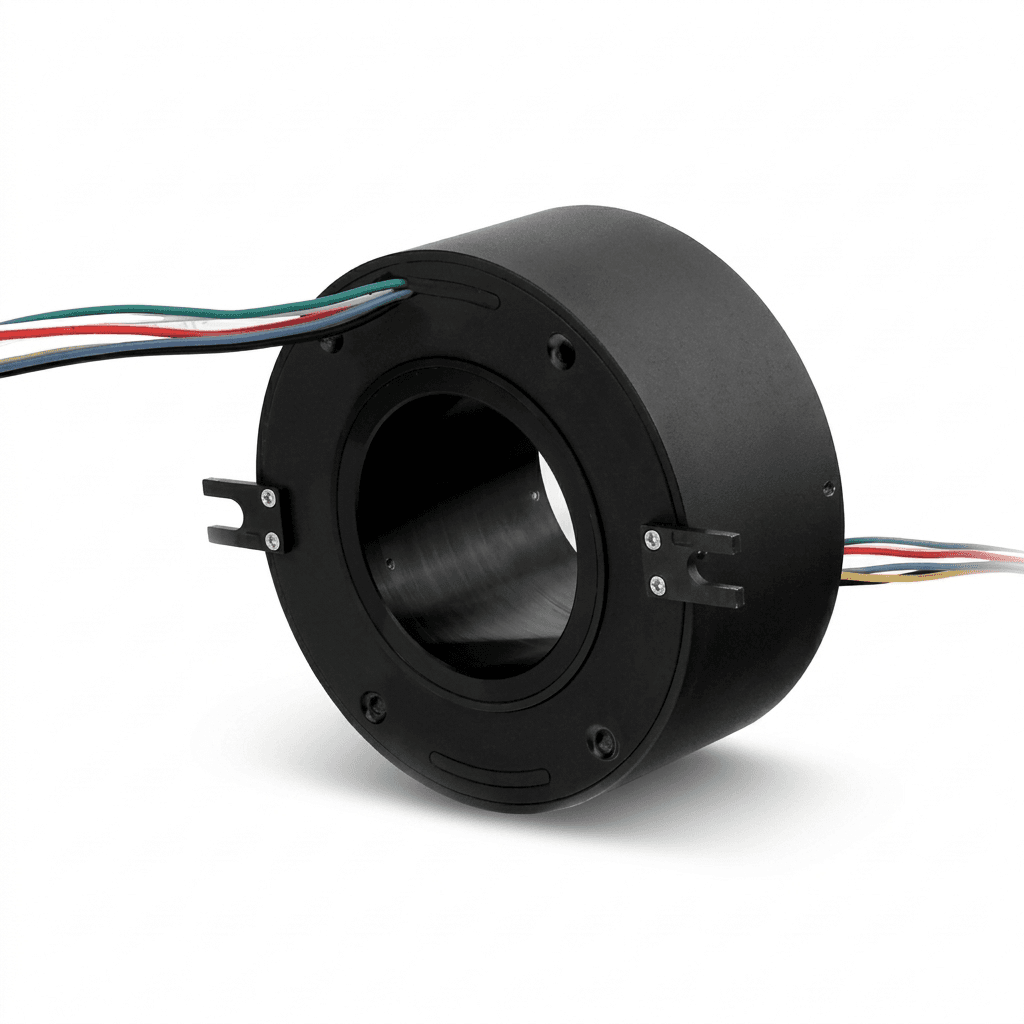
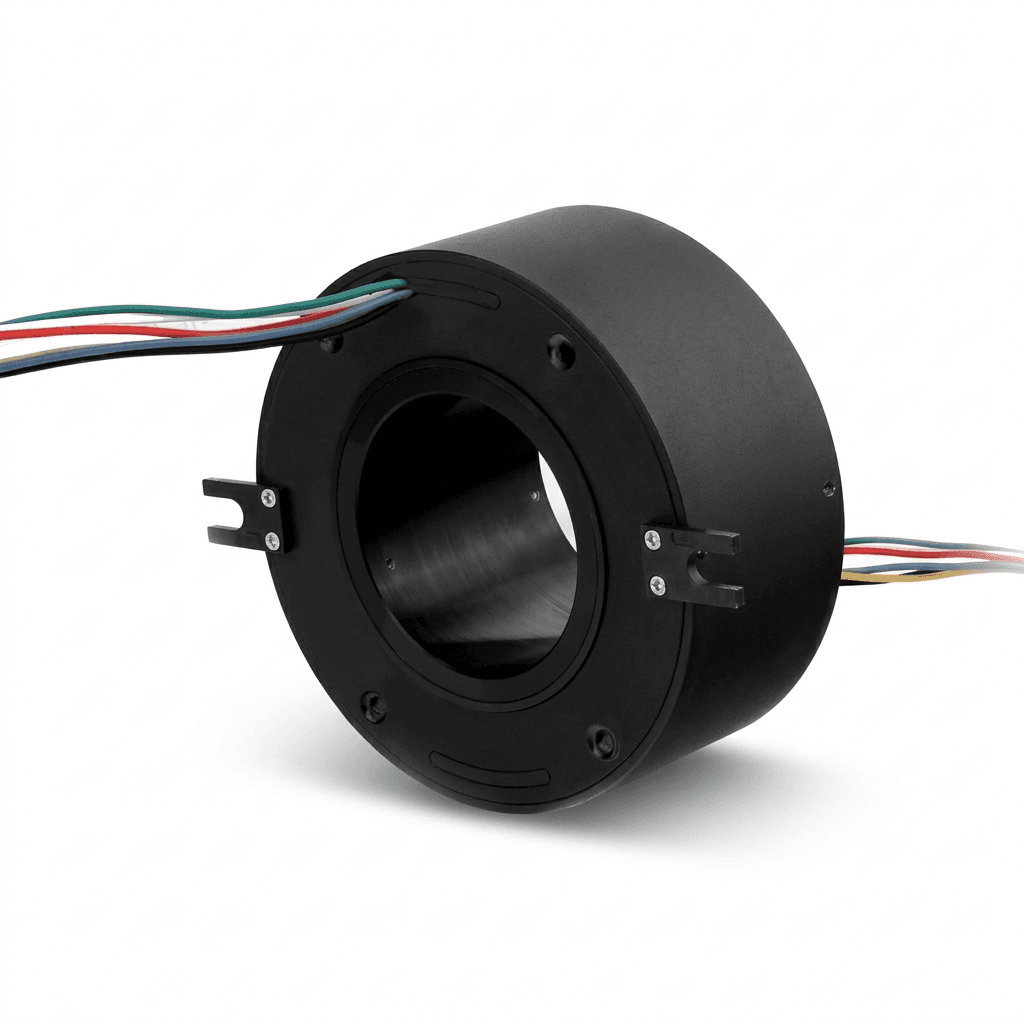
Procurement Action: Do not just ask the OEM for the bore diameter. Ask for their recommended cable flex lifecycle data. Many advanced joint modules incorporate a central slip ring module within the bore to allow infinite rotation without cable twisting, though this limits data bandwidth (e.g., standard slip rings may struggle with high-frequency EtherCAT signals).
2. Large-Bore Encoder Constraints
In a solid shaft, measuring absolute position is as simple as mounting a small magnetic or optical encoder disk at the end of the shaft. In a hollow-shaft module, the center is empty. Position must be measured at the periphery using a large-diameter ring encoder or an off-axis gear mechanism.
Procurement Action: Large bore optical encoders are incredibly precise but vulnerable to dust and shock. Large bore magnetic encoders are robust but can suffer from non-linearity. Ensure your supplier defines their absolute positioning accuracy after final assembly, not just the raw spec of the encoder chip.
3. Harmonic Drive Integration
Most high-precision joints use harmonic drives (strain wave gearing). The input element of a harmonic drive—the wave generator—must be hollow to match the motor. Machining a hollow wave generator and supporting it with thin-section bearings requires extreme precision. Any runout (eccentricity) in this assembly will manifest as torque ripple and accelerated gear wear.
Procurement Action: Ask for the OEM's incoming Quality Control (QC) documentation for thin-section bearings and wave generators. The best OEMs perform 100% dynamic runout testing on these sub-assemblies before final integration.
Sourcing Checklist for Joint Modules
Before you release an RFQ or approve a budget for engineering verification samples, use this checklist to ensure you have mapped the constraints of your chosen architecture.
- Establish the Envelope Requirement: Have you defined the maximum permissible outer diameter for the joint? If the envelope is extremely tight, a solid-shaft module might be your only physical option to hit the required torque.
- Define the Bore Size: If opting for a hollow shaft, have you calculated the exact diameter of the cable bundle (power, communication, I/O, pneumatics) that must pass through? Add a 20-30% clearance margin to prevent cable binding during rotation.
- Specify IP Rating Needs: Do you need IP54, IP65, or IP67? If IP67 is required with a hollow shaft, explicitly ask the OEM how the inner bore is sealed and request friction data (seals add drag).
- Lock the Encoder Requirement: Do you need single-turn absolute, multi-turn absolute, or incremental? Multi-turn absolute in a hollow-bore format often requires battery backup or complex mechanical gearing.
- Review Heat Dissipation: Hollow shafts have less thermal mass in the center. Request a continuous torque-speed curve detailing the thermal derating over a 60-minute continuous run.
- Verify Bearing Moment Load: If the joint will experience high radial or moment loads (e.g., a robot's base or shoulder joint), verify that the thin-section bearings of the hollow module can withstand the dynamic load cases without deformation.
When to Choose Solid vs. Hollow
Choose Solid-Shaft When:
- You are building high-speed SCARA robots or delta robots where cables do not need to traverse through the rotational axis of multiple stacked joints.
- You are developing legged robots (quadrupeds) or certain humanoid lower-body joints where maximizing torque-to-weight ratio and shock absorption is far more critical than internal cable routing.
- You are operating under strict budget constraints and need to leverage mature, low-cost supply chains for encoders and gearboxes.
Choose Hollow-Shaft When:
- You are designing collaborative robot arms (cobots) where external cables present an unacceptable snag hazard or aesthetic penalty.
- The joint requires infinite rotation (using an integrated slip ring inside the bore).
- You are building multi-axis medical robotics or inspection robots where strict clean-room or sterilization requirements forbid complex external cable management systems.
Frequently Asked Questions (FAQ)
Q: Does a hollow-shaft module have worse backlash than a solid-shaft module? A: Not inherently. The backlash is primarily determined by the reduction gear technology (e.g., harmonic drives generally have zero or negligible backlash). However, because hollow-shaft modules rely on thin-section bearings, poor machining tolerances can introduce hysteresis or lost motion that mimics backlash.
Q: Can I run high-voltage power lines and high-speed data lines through the same hollow bore? A: Yes, but electromagnetic interference (EMI) is a major risk. Because the cables are packed tightly inside a metal bore right next to a high-power electromagnetic stator, data lines (like EtherCAT or CAN bus) must be heavily shielded.
Q: How much does the hollow-shaft feature add to the cost of a joint module? A: While prices vary widely based on scale and precision, expect a 15% to 40% cost premium over a solid-shaft module of equivalent torque. This premium is driven by the cost of large-bore encoders, thin-section bearings, and more complex housing machining.
Q: If a cable breaks inside a hollow-shaft joint, is the module ruined? A: Not the module itself, but replacing the cable bundle usually requires disassembling the entire robot arm distal to that joint. This is why validating cable torsional fatigue life during prototyping is absolutely critical.
Conclusion and Next Steps
The choice between a hollow-shaft and solid-shaft robotic joint module sets the trajectory for your entire mechanical design and supply chain strategy. Solid shafts offer undeniable advantages in torque density, cost, and simplicity. Hollow shafts deliver the clean, integrated aesthetic and safety profiles demanded by modern cobots and service robots, but require rigorous validation of cable lifecycles, encoder performance, and bearing rigidity.
Ensure your procurement strategy aligns with these technical realities before committing to a final footprint.
Sources and References for Further Review
- Harmonic Drive integrated actuator reference: compact servo actuator architectures for robotic axes and hollow-shaft integration trade-offs. harmonicdrive.net
- Moog slip ring reference: electromechanical slip ring options for rotating power and signal transmission where continuous joint rotation is required. moog.com
- Harmonic Drive engineering data portal: additional gearbox and actuator documentation for rigidity, precision, and integration review. harmonicdrive.net
Start Your Sourcing Project
If your team is currently defining the specifications for a new robot arm platform and needs to evaluate both hollow-shaft and solid-shaft actuator options, our engineering team can provide detailed CAD models, thermal run data, and customized EVT samples.
- Contact our application engineers: [email protected]
- Request pricing and lead times via WhatsApp: +86 18857971991
- Explore our standard product catalog for baseline specifications.
Categories
More Posts
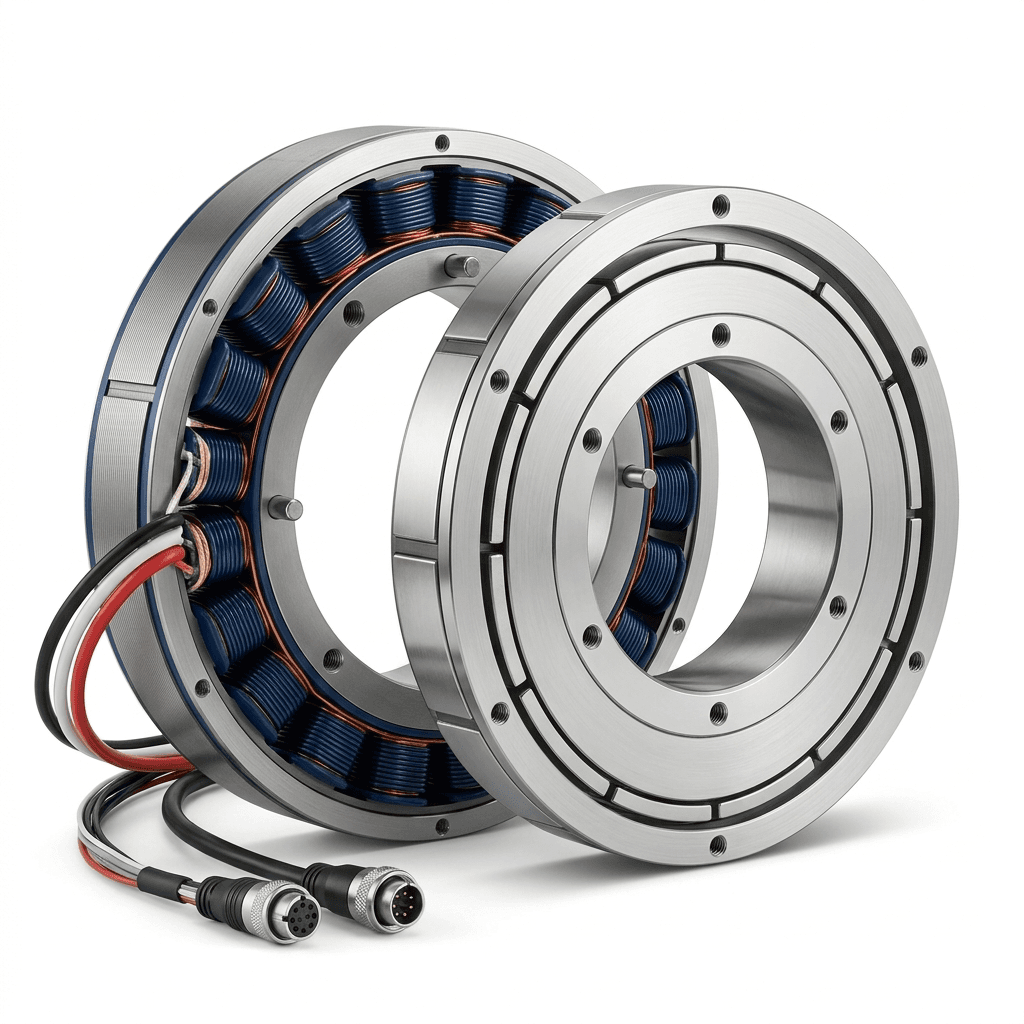
Frameless Torque Motor Guide: Outrunner vs Inrunner for Robotic Joints
A practical comparison of outrunner and inrunner frameless torque motors for cobot, humanoid, and precision motion applications.

Dual vs Single Encoder Robot Joint Modules: Procurement Guide
Compare dual vs single encoder robotic joint modules for cobots and humanoids, with supplier questions, trade-offs, sourcing limits, and RFQ guidance.
Robot Joint Module Thermal Management & Derating Guide
A comprehensive guide for engineers and procurement teams on understanding thermal derating, continuous torque limits, and heat mitigation strategies in robotic joint modules.