Strain Wave vs. Cycloidal Drive in Robot Joint Modules: Sourcing Guide
A comprehensive engineering and procurement guide comparing strain wave and cycloidal drives in robotic joint modules. Evaluate payload, backlash, and costs.
When specifying a robotic joint module, the reduction gear is the most critical component dictating cost, lifespan, and performance. For most humanoid, cobot, and industrial robot applications, the choice narrows down to two dominant technologies: Strain Wave Gearing (commonly known by the brand name Harmonic Drive) and Cycloidal Drives.
For procurement teams and lead engineers, selecting between these two is not just a technical preference—it dictates your entire bill of materials (BOM), thermal management strategy, and the types of applications your robot can handle.
This guide provides a structured comparison to help you evaluate which gearbox architecture makes the most sense for your custom robot joint module.
Scope note, last reviewed July 24, 2026: This guide is for global sourcing of integrated robotic joint modules in humanoid arms, cobots, SCARA/6-axis robots, and heavy industrial manipulators. It compares gearbox architecture for early supplier screening; final sizing still requires supplier torque curves, duty-cycle testing, thermal rise data, and emergency-stop validation on your joint assembly.
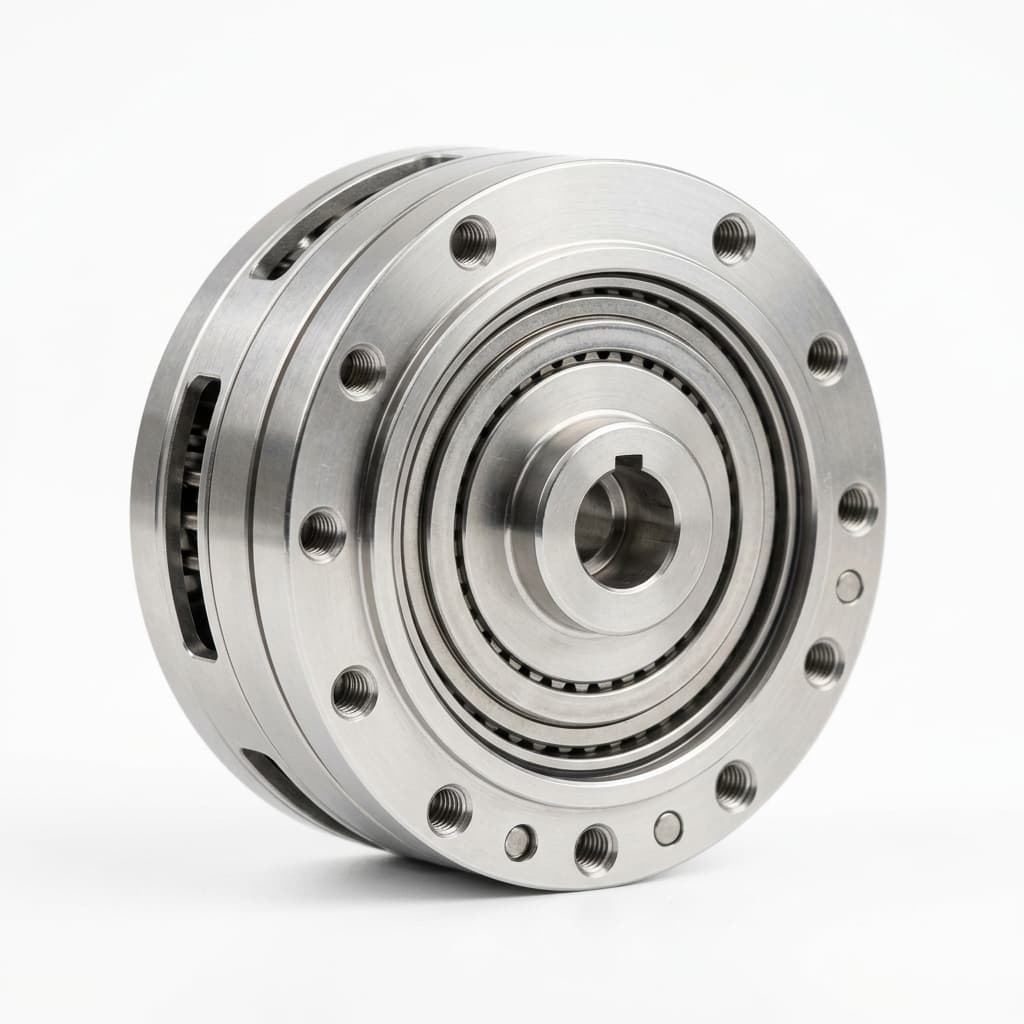
Engineering Visualization: Gear Reduction Impact on Joint Profile
Core Architectural Differences
Before diving into specifications, it is crucial to understand how they work, as this explains their failure modes.
- Strain Wave Drives: Rely on the elastic deformation of a thin-walled metal cup (the flexspline) with external teeth engaging a rigid circular spline. Because it relies on metal flexing, it is inherently limited in shock resistance but excels in zero-backlash precision.
- Cycloidal Drives: Use rolling elements (pins and cycloidal discs) rather than flexing metal. The eccentric rotation creates immense reduction ratios in a small space. Because forces are distributed across many sturdy pins, it boasts massive shock load capabilities.
Strain Wave vs. Cycloidal: Technical & Commercial Comparison
For a purchasing or engineering team, the theoretical differences translate into concrete sourcing trade-offs.
| Evaluation Metric | Strain Wave (Harmonic) | Cycloidal Drive | Impact on Robot Design |
|---|---|---|---|
| Typical Payload Focus | Light to medium axes, especially cobot and humanoid wrists or elbows | Medium to heavy axes, base joints, positioners, and industrial robot arms | Determines arm scale and where mass can be tolerated. |
| Backlash & Precision | Zero backlash is achievable in properly selected strain wave units | Very low backlash; supplier data may list hysteresis loss below 1 arc-min for specific RV models | Cobot positioning may favor strain wave; heavy-axis repeatability often favors cycloidal stiffness. |
| Shock Load Capacity | Lower impact margin; flexspline fatigue or ratcheting risk must be controlled | Higher short-term overload capability; verify emergency-stop torque against the supplier curve | Defines crash recovery, safety factor, and controller torque limiting. |
| Physical Profile | Very compact, with minimal axial length and low distal-joint mass | Wider radial footprint and more mass, but higher integrated bearing and moment-load capacity | Affects joint outer diameter, arm inertia, and cable/encoder packaging. |
| Cost at Scale | Moderate to high due to flexspline metallurgy and precision assembly | High due to precision pins, discs, bearings, and preload control | Affects BOM and whether the gearbox should be sourced as a bare reducer or integrated module. |
| Thermal Dissipation | Needs a deliberate housing heat path, especially in sealed compact joints | Larger thermal mass and housing contact can make heat rejection easier | Defines whether the module needs derating, active cooling, or lower continuous torque. |
| Supplier Evidence to Request | Flexspline fatigue life, ratcheting limit, torsional stiffness curve, and assembly concentricity | Rated torque, acceleration torque, emergency-stop torque, hysteresis loss, lubrication, and bearing load data | Turns the comparison from a generic preference into an auditable RFQ checklist. |
Procurement & Engineering Checklist
When auditing OEM joint module suppliers, do not accept generic datasheets. Use this checklist during your RFQ process:
- Shock Load Ratings: Did the supplier provide peak impact torque limits? (Crucial if choosing strain wave).
- Stiffness Curves: Ask for the torsional stiffness curve, not just a single number.
- Thermal Derating: Request the continuous run temperature rise data at your target ambient temperature.
- Lubrication Leaks: How is the gearbox sealed? (Cycloidal drives require specific greasing and robust IP65/IP67 seals to prevent leakage).
- Integration Tolerance: Does the OEM assemble the gearbox in a clean-room? Poor assembly introduces periodic torque ripple.
- Lead Times: High-quality reduction gears are notorious for long lead times. Verify the supplier's inventory of bare drives.
If you are comparing two supplier datasheets and the duty-cycle or shock-load margins are unclear, send the RFQ pack through our engineering sourcing review before committing to prototype tooling.
Frequently Asked Questions (FAQ)
Q: Can I use a cycloidal drive for a lightweight cobot? A: You can, but it is usually overkill. The added weight of a cycloidal drive at the distal joints (wrist) increases the inertia of the arm, forcing you to use larger motors at the base. Strain wave is heavily preferred for cobots under 15kg payloads.
Q: Why do strain wave gears fail? A: The most common failure mode is ratcheting (teeth slipping over each other during a shock load) or fatigue cracking of the flexspline. This is why limiting impact forces through control algorithms is essential.
Q: Do these gear types require different motor types? A: Both typically pair with high-speed, low-torque frameless BLDC motors. The motor choice doesn't change, but the mechanical coupling and thermal interface of the joint module must be tailored to the specific gearbox.
Conclusion and Next Steps
Choosing between a strain wave and a cycloidal drive is the foundational decision of your robot joint module architecture. If you are building lightweight collaborative robots or humanoid arms, the compactness of strain wave is unbeatable. If you are designing heavy-duty industrial manipulators, the ruggedness of cycloidal is mandatory.
When you are ready to move from specification to prototyping, validating the complete module—motor, encoder, and gearbox together—is essential. Contact our engineering team with your payload and speed requirements, and we can help specify the optimal integrated joint module for your next robotic platform.
Sources and References
More Posts
Robot Joint Module Thermal Management & Derating Guide
A comprehensive guide for engineers and procurement teams on understanding thermal derating, continuous torque limits, and heat mitigation strategies in robotic joint modules.

Functional Safety (STO & SBC) in Integrated Joint Modules: A Procurement Guide
Evaluate functional safety, STO, and SBC requirements for robotic joint modules, with sourcing checks for engineers and procurement teams before a vendor RFQ.
Hollow-Shaft vs Solid-Shaft Robot Joint Modules: A Sourcing Guide (2026)
An engineering and procurement guide to evaluating hollow-shaft versus solid-shaft robotic joint modules for humanoid, cobot, and industrial robot arms.